
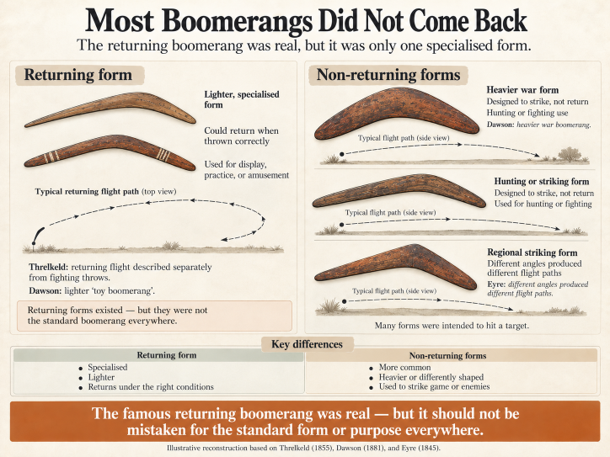
KEY FINDING: Return flight was not the defining feature of every boomerang. Nineteenth-century writers distinguished different shapes, throws and purposes, including heavier hunting and fighting forms intended to hit a target rather than return.
The returning boomerang dominates the modern image
The most famous boomerang is the one that curves through the air and returns towards the thrower. That performance is genuine and remarkable. The mistake is assuming that all Aboriginal objects now grouped under the word boomerang were designed to behave that way.
The National Museum of Australia makes the modern distinction plainly: some boomerangs are designed to return, but the vast majority are not. [1] Nineteenth-century descriptions explain why that broader family existed.
Threlkeld described different throws for different purposes
Missionary-linguist Lancelot Threlkeld wrote about the Lake Macquarie tur-rur-ma in 1855. His description distinguished the spectacular returning throw from throws used in fighting. He treated the returning flight as an amusement or display, while other techniques were intended to strike and injure.
That is important because it comes from a writer who knew the local language and had spent decades recording it. He was not describing one universal aerodynamic trick; he was describing an object with multiple techniques and functions.
Different regions made different forms
Independent nineteenth-century writers describe the same broad distinction. Edward John Eyre recorded forms with different angles and markedly different flight behaviour. James Dawson distinguished a lighter, more curved western Victorian form that could return from a heavier war boomerang that did not.
The aerodynamic point follows the historical descriptions: some forms could return under the right throw, while others were heavier, straighter or purpose-built to strike a target. A weapon intended to carry energy into an animal or opponent did not need to return to the thrower.
The English label can hide those differences
Different Aboriginal languages used different names for different throwing weapons. As the English word boomerang became a broad colonial label, regional distinctions became easier to overlook. The naming history is dealt with separately in the next article; the important point here is that the objects themselves were not functionally identical.
The returning type later became the most memorable public image through demonstrations, sport, souvenirs and national symbolism. That specialised behaviour should not be treated as the defining feature of every traditional form.
The fact worth preserving
Different Aboriginal peoples used both returning and non-returning boomerang forms. Historical sources describe both, but their distribution and functions varied by region.
The more accurate picture is therefore not “a boomerang always comes back” but “some boomerangs were designed or thrown to return, while many hunting and fighting forms were intended to go where they were thrown.”