
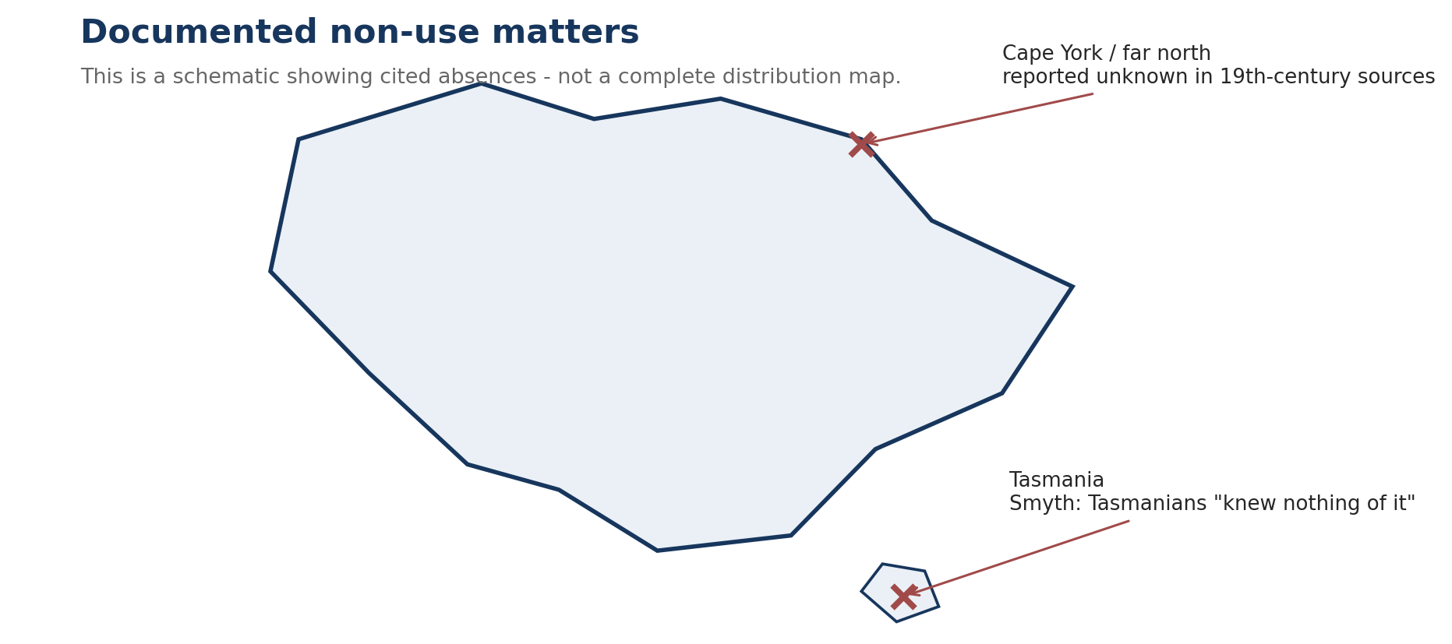
KEY FINDING: Boomerangs were long-established among many Aboriginal peoples in Australia, but they were not used by all groups or in all regions. Nineteenth-century sources record clear regional non-use, while rock art shows that in some northern regions later absence did not necessarily mean absence in the deeper past. Distribution, form and function all varied by place and period.
A national symbol can still have a regional history
Few objects are more closely associated with Aboriginal Australia that the boomerang. That modern symbolism can make it easy to assume that every Aboriginal society possessed the same weapon or throwing tool. Nineteen-century evidence says otherwise.
R. Brough Smyth wrote in 1878 that the boomerang was “not known in all parts of Australia”. He specifically drew attention to places where it was absent and to uncertainty about its early use in some other districts.
Cape York provides direct evidence of non-use
The far north is particularly important. A Queensland government report from Somerset in 1865 described local weapons and tools but stated that the boomerang and nulla nulla were unknown. Smyth later cited John Jardine, the police magistrate at Somerset, for the same point.
John MacGillivray had made a similar observation in 1852. During the voyage of HMS Rattlesnake he described a boomerang obtained farther south on the north-east coast and noted that the weapon was unknown farther north, from Cape York towards Port Essington. These are independent nineteenth-century observations from different writers.
Tasmania is an even clearer exception
Smyth also stated that Tasmanian Aboriginal people “knew nothing of it”. Whatever debates remain about particular mainland boundaries, Tasmania alone is enough to disprove the idea that the boomerang was a universal Aboriginal object across the entire continent and its islands.
That does not imply an absence of sophisticated Tasmanian weapons or technology. It means only that different Aboriginal societies developed and retained different material cultures.
Where boomerangs were used, they were not one standard object
Regional variation continued within areas of use. Smyth distinguished different Victorian forms and names, including the wonguim and barngeet, and commented on unusually thin western examples. Other sources describe heavier fighting and hunting weapons as well as returning forms.
The result is a more complex historical picture: not a continent carrying one standard boomerang, but many communities with different local weapons, forms, names and techniques – including communities that did not use a boomerang at all.
Modern symbolism came later
The National Museum of Australia describes the boomerang as an internationally recognised symbol of Australia and notes its later use in tourism, transport, advertising and souvenirs. That modern national career is important, but it is different from the question of traditional distribution.
As with the didgeridoo, a real Aboriginal object can become a symbol of Aboriginal Australia as a whole without having been traditionally used in every Aboriginal society.
The fact worth preserving
The correct conclusion is not that the boomerang was somehow “less Aboriginal” because it was regional. The opposite is more useful: Aboriginal Australia contained many separate technological traditions, and the boomerang was one of them.
Its national symbolism is real. Its traditional distribution was uneven. Both facts can be true at the same time.