
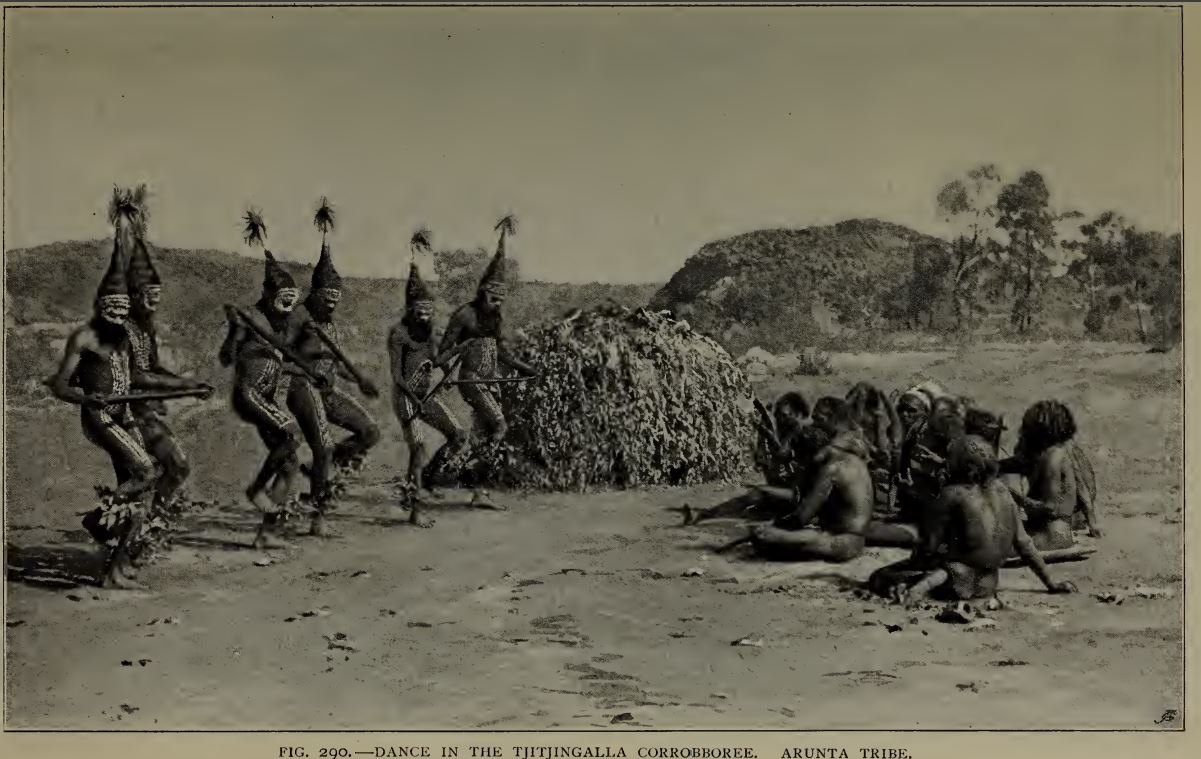
The corroboree was far more than a simple dance; it was the central pillar of Aboriginal cultural, social, and spiritual life. Anthony Trollope defined it as “a tribal dance in which the men congregate out in the bush, in the front of a fire, and go through various antics with smeared faces and bodies, with spears and sticks, howling, and moving their bodies about in time.”
However, other accounts reveal a much deeper significance. Roderick J. Flanagan described it as the “great festival among the New Hollanders,” encompassing “all the festivity and fun of which the aboriginal is cognizant, or in which he indulges. It is at once his Bacchanal, Cyprian and Olympian games.”
Here, songs and orations were recited, musical performances accomplished, dances performed, and amours and courtship indulged. The Rev. George Taplin, in “The Narrinyerri,” further specified that while used as a charm to frighten away disease and in some ceremonies, “its real character is only that of a song and a dance.”
Corroboree Name Variations
The term “corroboree” (and its variations “corrobory,” “corrobery,” “corrobboree,” “corrobberree”) was commonly used by white observers and adopted by some natives after hearing it.
However, different language groups had their own names. Taplin noted that what whites call a corrobery is called by the Narryinyeri, ringbalin. Baldwin Spencer and F.J. Gillen noted that in the central Australian tribes they studied, the word “corrobboree” was often adopted by natives after hearing white men use it, with their own word for sacred ceremonies being “Quabara.”
The Uses of the Corroboree
The corroboree served a vast array of purposes, which can be grouped into several key functions:
- Social and Diplomatic Function: Roderick J. Flanagan stated a corroboree was held as a sequel to a battle, or on the occasion of a friendly meeting or consultation between two or more tribes. Spencer and Gillen, in The Native Tribes of Central Australia, described a “great corroboree” which was a “rejoicing” at his arrival, and another held when over a thousand people from about ten different tribes gathered. May Vivienne witnessed a corroboree that was a rival amusement to a Bachelors’ Ball held by white settlers.
- Sacred and Ceremonial Function: This was the corroboree’s most profound use. Spencer and Gillen detailed its role in male initiation ceremonies (the Engwura), where it was a crucial, sacred process. R.N. Richard Sadleir recorded a corroboree held about 200 miles from Sydney for the specific purpose of making rain. In “Kamilaroi and Kurnai,” it is noted that “Birraarks” derived their “corrobboree songs and dances from the ‘ghosts’ of the ancestors,” and among the Gournditch-mara and Turra tribes, special men learned songs from departed spirits.
- Theatrical and Mimetic Function: Many corroborees were elaborate plays. Gideon S. Lang provided a detailed account of a “grand corroboree” representing a herd of cattle feeding, being hunted by blacks, and a subsequent battle with white stockmen. R.N. Richard Sadleir also described a performance where 500 people represented a herd of cattle, a troop of horses, stockmen, and a sham-fight.
- A Marker of Cultural Identity Function: As stated in “Kamilaroi and Kurnai,” despite differences, all Kurnai were bound together by “the same corroboree-songs and dances.”
Time of Day the Corroboree Is Performed
The corroboree was overwhelmingly a nocturnal event. Anthony Trollope, William Landsborough, May Vivienne, Lady Barker, and Roderick J. Flanagan all specifically mention that it was held at night. The dramatic effect was heightened by firelight; Flanagan noted that “the effect of such scenes by moonlight, or by the glare of bush fires, is said to be striking in the extreme.” R.N. Richard Sadleir also described the “fires lighting up the night.”
However, The Narrinyerri account mentions a mythical corroboree held by ancestors “in the daytime” when there is no fire.
Duration of Corroboree Performance
The length of a corroboree could vary dramatically, from a single evening to a marathon of ceremonies lasting weeks. Most accounts from observers like Trollope, Vivienne, and Lady Barker describe performances that lasted for a few hours on a single night.
Spencer and Gillen recorded the Atnimokita corroboree, which occupied ten evenings. For major sacred events, the duration was extensive. Spencer and Gillen documented that an “important” corroboree could occupy “ten days or a fortnight.” The Engwura ceremony they described lasted for several months. R.N. Richard Sadleir also mentioned a ceremony on the Macleay River that occupied “a fortnight or more.”