
Observation of the Corroboree through a Colonial Lens The provided texts are unified by a consistent perspective: that of the outside observer, almost always a European colonist, settler, or official, describing the corroboree through their own cultural framework. Their descriptions frequently convey a sense of alienation, judgment, and a failure to comprehend the ceremony’s deeper […]
Musical Performance in the Aboriginal Corroboree The musical accompaniment for the corroboree was a complex and integral part of the performance, involving specific instruments, vocal techniques, and rhythmic patterns, all designed to create a powerful, often overwhelming, sonic experience. Instruments and Rhythmic Accompaniment Used During Aboriginal Corroboree The rhythm for the dances was provided by […]
A Corroboree Example: The Sham Fight with White Settlers Following the cattle hunt, the performance would often transition into a dramatic battle reenactment. Gideon Lang’s account continues: The next scene began with “the sound of horses galloping through the timber, followed by the appearance of a party of whites on horseback, remarkably well got up.” […]
The Sacred Corroboree The sacred Corroborees were of a profoundly different character, relating to deep spiritual and legal foundations of Aboriginal life. Access was strictly forbidden to the uninitiated, which included all women, children, and outsiders. Purpose and Nature Initiation and Law: Baldwin Spencer and F.J. Gillen, in their detailed anthropological works, consistently differentiate […]
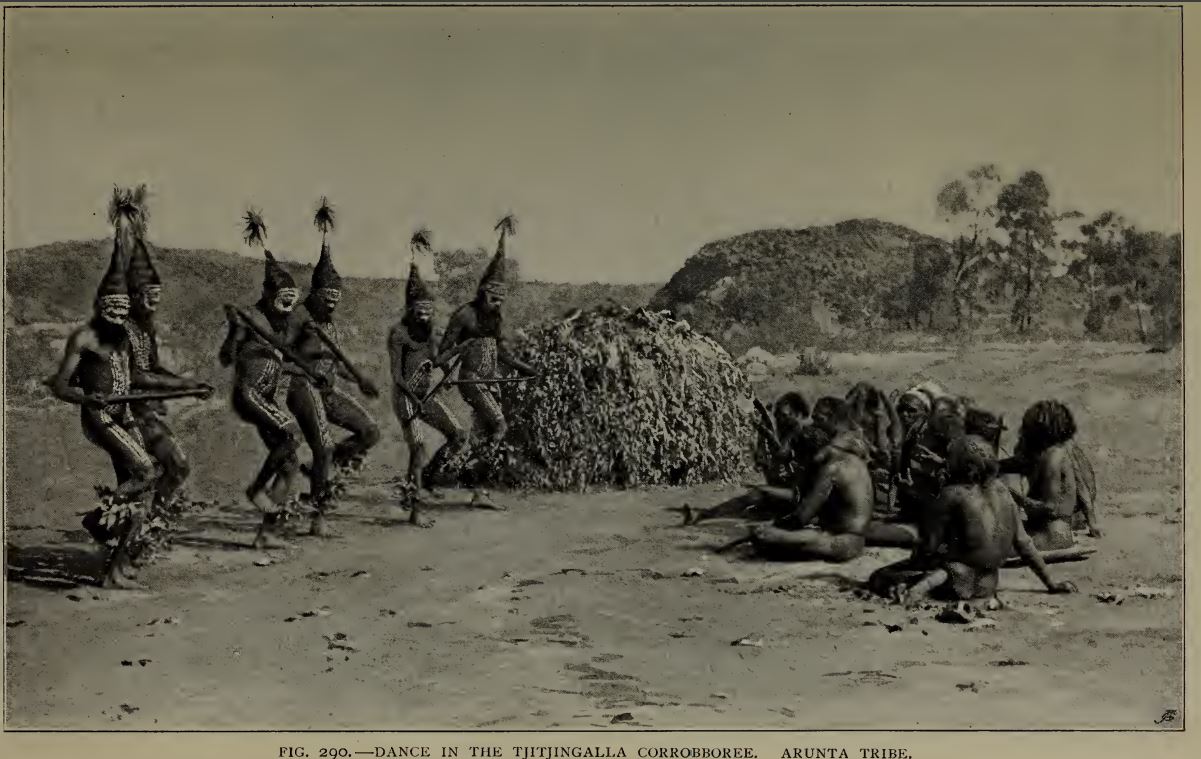
Size of Gathering The scale of a corroboree ranged from small, intimate gatherings to massive inter-tribal meetings. Samuel Smiles referred to “a few miserable” blacks meeting, and William Landsborough described a dance performed by two individuals for a small audience. R.N. Richard Sadleir reported assemblies of 500 people. Lady Barker witnessed a performance by 120 […]
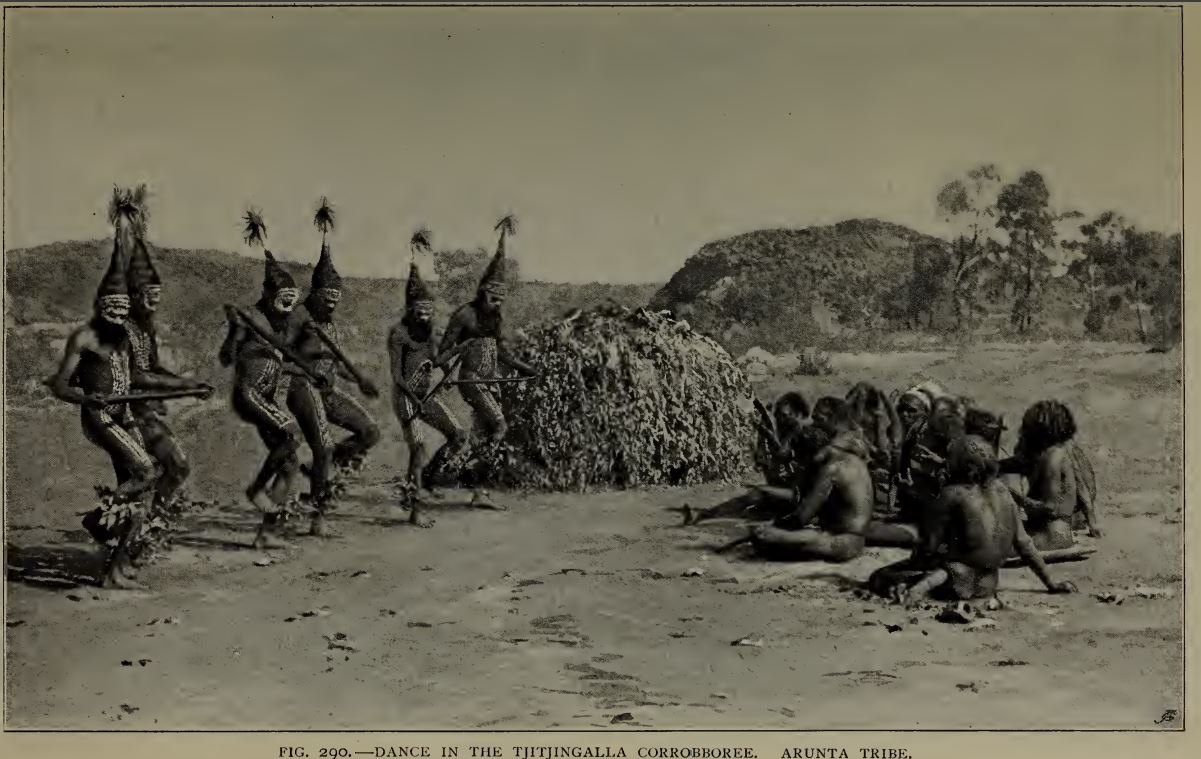
The corroboree was far more than a simple dance; it was the central pillar of Aboriginal cultural, social, and spiritual life. Anthony Trollope defined it as “a tribal dance in which the men congregate out in the bush, in the front of a fire, and go through various antics with smeared faces and bodies, with […]
Corroborees played a significant role in social and diplomatic contexts among Aboriginal tribes. According to Roderick J. Flanagan, these gatherings were often held as sequels to battles or as occasions for friendly meetings and consultations between tribes. John Morgan, in his account of William Buckley, described a “great corroboree” held as a rejoicing upon Buckley’s arrival, and another that brought together over a thousand people from approximately ten different tribes, highlighting their role in large-scale social cohesion.
The sacred and ceremonial aspect of corroborees was perhaps their most profound dimension. Spencer and Gillen documented their integral role in male initiation ceremonies, such as the Engwura, where corroborees were essential sacred processes. R.N. Richard Sadleir recorded a corroboree held specifically for rain-making approximately 200 miles from Sydney, demonstrating their connection to spiritual and practical needs.
Furthermore, as noted in “Kamilaroi and Kurnai,” the “Birraarks” derived their corroboree songs and dances from ancestral ghosts, and among tribes like the Gournditch-mara and Turra, special men learned these songs directly from departed spirits, emphasizing the deep spiritual lineage of these performances.
Many corroborees were elaborate theatrical performances that mimicked real-life events. Gideon S. Lang gave a detailed account of a “grand corroboree” that depicted a herd of cattle feeding, being hunted by Aboriginal people, and a subsequent battle with white stockmen, illustrating how these events incorporated contemporary themes. Similarly, R.N. Richard Sadleir described a large-scale performance involving 500 participants who represented a herd of cattle, a troop of horses, stockmen, and engaged in a sham-fight, showcasing the mimetic and dramatic capabilities of these gatherings.
Corroborees also served as a powerful marker of cultural identity. As highlighted in “Kamilaroi and Kurnai,” despite variations among different groups, all Kurnai people were united through shared corroboree-songs and dances. This common cultural practice reinforced social bonds and maintained a collective identity across the tribe, underscoring the unifying power of these traditions.
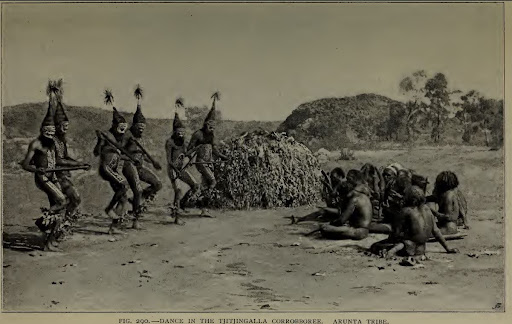
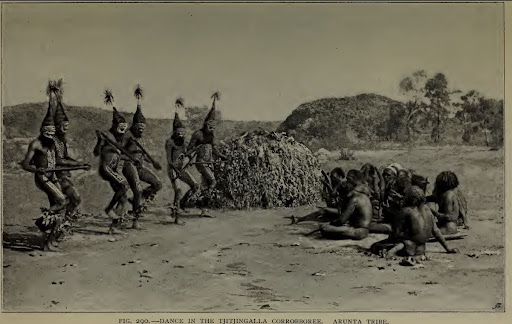
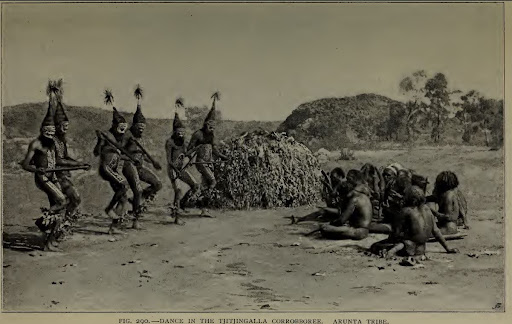
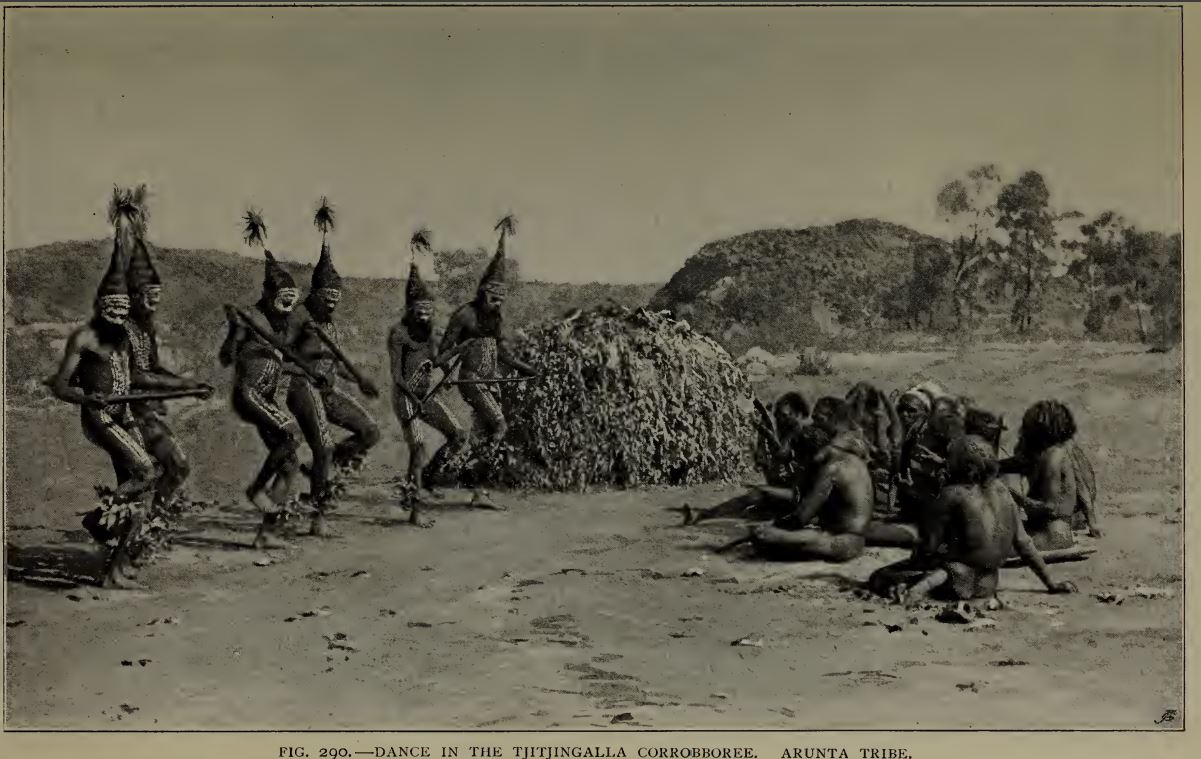
Anthony Trollope defined a corroboree as “a tribal dance in which the men congregate out in the bush, in the front of a fire, and go through various antics with smeared faces and bodies, with spears and sticks, howling, and moving their bodies about in time;—while the gins, and children, and old people sit round in a circle.”
Roderick J. Flanagan described it as the “great festival among the New Hollanders,” encompassing “all the festivity and fun of which the aboriginal is cognizant, or in which he indulges. It is at once his Bacchanal, Cyprian and Olympian games. Here, songs and orations were recited, musical performances accomplished, dances performed, and amours and courtship indulged.”
The Rev. George Taplin, in “The Narrinyeri,” further specified that while used as a charm to frighten away disease and in some ceremonies, “its real character is only that of a song and a dance.”
The sources describe a consistent and strict division of roles between men and women during most corroborees.
The central dramatic action of the corroboree is performed by the men. Anthony Trollope described it as “a tribal dance in which the men congregate… and go through various antics.” Roderick J. Flanagan elaborates that the corroboree features “eighty or a hundred men ranged in a line… performing a measured dance,” and it is the “scene of their songs and orations.” May Vivienne observed the men “leaping up in the air… and contorting their bodies in most grotesque fashion.”
The women’s primary role is to provide the music and rhythm for the male dancers. Flanagan explicitly states that “the women [are] the instrumental performers, as well as sustaining the chief burden of the vocal music.” This is described in multiple accounts:
William Buckley observed that the women sat on the ground, beating time on skin rugs rolled up tightly, which they stretched between their knees to form a sort of drum. May Vivienne noted that while the men danced, other men “squatted on the ground chanting strange sounds and beating sticks, while the lubras (wives), gins (girls), and pickaninnies (children) sat or lay around, making a fearful noise and clapping their hands vigorously.”
The account from “The Narrinyerri” specifies that in most ringbalin, “only the men dance; the women sit on the ground and sing.” They beat the planggi (skin drums) and form the core of the choir.
The decoration of the body for corroborees is a serious art form, with distinct differences between men and women.
The men’s adornment is often elaborate and dramatic, designed to create a striking, sometimes fearsome, spectacle in the firelight. They paint themselves, use feathers and accessories and leafy anklets.
William Landsborough described his guides painting themselves with “white streaks” so that in the firelight they “looked like skeletons.” Lady Barker gave a detailed account of prisoners painting themselves with “a streak of some white clay between each rib, and similar daubs of white and a red pigment… smeared all over their faces, in a pattern or design.” R.N. Richard Sadleir mentions bodies “striped in white” and heads “fancifully adorned.”
Lady Barker noted the men’s heads were decorated to look “more like a crow’s nest than anything else.” Sadleir describes one tribe where the men’s hair was “stuck all over with the snowy down of the white cockatoo.” Dancers often carried spears, shields, clubs (waddies), and boomerangs.
A common feature mentioned by Baldwin Spencer and F.J. Gillen is that the performers had “bundles of leafy twigs tied round the legs just above the ankles.”
However, when the women dance in their own ceremonies, their adornment is different. Spencer and Gillen provide a specific description from the Arunta tribe: “Each woman had a broad, white band of down across her forehead… [and] a long string, made out of the same material, hanging pendent from the head-band.” They also note that the body designs for women’s dances were “quite unlike that seen at any time on the men,” consisting of lines and geometric shapes drawn on the chest and abdomen, and an “elongate ellipse” on each thigh. The material used was sometimes the white fur from rabbits’ tails.
While the major nocturnal ceremonies are typically male-dominated, the sources confirm that women have their own distinct dances and corroborees.
George Taplin in The Narrinyeri states directly, “There are also war dances… The dances of the women are very immodest and lewd. The men sit and sing, and the women dance.” He compares a drawing of Egyptian dancers to the dances of Narrinyeri women, finding it “exact.”
Baldwin Spencer and F.J. Gillen in The Native Tribes of Central Australia describe a special woman’s dance that forms part of the final phase of the major Engwura ceremony. They write: “A number of young women… are decorated with a double horseshoe-shaped band of white pipe-clay which extends across the front of each thigh and the base of the abdomen.” In this dance, the women stand in a group, swaying and “quivering in a most remarkable fashion… the muscles of the thighs and of the base of the abdomen.”
In most sacred ceremonies, women are strictly forbidden. However, Spencer and Gillen note an exception in the Arunta tribe where, during certain major gatherings, women perform a dance that re-enacts a mythological event. They write that at the start of one initiation ceremony, “the women, who had been awaiting his arrival, at once began to dance, carrying shields in their hands.” This was unusual, as “except in connection with this ceremony women may never carry shields, because they are exclusively the property of the men.”
As noted by Richard Sadleir, the Government granted supplies of flour and stores. To specifically check infanticide, tea and sugar were given to the mother until the infant was twelve months old. This practice of providing a ration of flour, tea, and sugar to every mother until her child was twelve months old was adopted and, according to Taplin, it put a stop to infanticide.
"*" indicates required fields