
Size of Gathering
The scale of a corroboree ranged from small, intimate gatherings to massive inter-tribal meetings. Samuel Smiles referred to “a few miserable” blacks meeting, and William Landsborough described a dance performed by two individuals for a small audience.
R.N. Richard Sadleir reported assemblies of 500 people. Lady Barker witnessed a performance by 120 prisoners in a jail. The largest gathering described is in John Morgan’s account, where “over a thousand souls” from “about 10 different tribes” assembled for a “grand corroboree.”
How Corroboree Songs Are Composed
According to historical accounts, Corroboree songs originate from two primary sources: the experiences of traveling individuals and direct revelation from the spirit world.
Corroboree Songs Composed from Travel and Experience
R.N. Richard Sadleir in “The Aborigines of Australia” confirms that songs are often based on contemporary events: “They make up their song out of some incident or circumstance they may have seen.” The most detailed account comes from “The Narrinyerri: an account of the tribes of South Australian Aborigines…” which states that songs are often created to describe recent events. The process is described as follows:
“A party will go to the country of another tribe; then one of them, who has the talent, will make up a song, descriptive of what they saw, and the adventures which happened to them. This will be learnt by the others; and they will sing it at the first corrobery in the tribe. At other times a hunting adventure will form the subject of such a song.”
Corroboree Songs Composed through Spiritual Revelation
Several sources indicate that songs are not always composed by ordinary individuals, but are also received from the spirit world by specific gifted persons. According to “Kamilaroi and Kurnai” in the Turra tribe, Gurildris (or Gureldres) were “men who professed to learn corroboree songs and dances from departed spirits. They also professed to learn songs for the dead, which were sung to make happy the departed who were gone to another country to live for ever, but to return no more.”
Also, the sources show that songs are adapted to various circumstances. May Vivienne, in “Travels in Western Australia,” notes: “The dances, or corroborees, are adapted to the various circumstances of their lives—marriage, birth, death, war or hunting.”
Ordinary Corroboree versus Sacred Corroboree
Based on the historical accounts, the term “corroboree” described two distinct categories of Aboriginal Australian gatherings: one was a common, often secular, social event, while the other was a secret-sacred ceremony central to spiritual belief and law.
The Ordinary Corroboree
The ordinary corroboree was the most frequently described form of corroboree, often performed for social amusement, storytelling, and to welcome other tribes or even curious white settlers.
Anthony Trollope described it as a “tribal dance” arranged for the “amusement of the guests” at the Rottnest prison.
Roderick J. Flanagan called it the “great festival” and “his Bacchanal, Cyprian and Olympian games” where “songs and orations are recited, his musical performances are accomplished, his dances performed, and his amours and courtship indulged.” Gideon S. Lang and Lucas provide detailed accounts of corroborees that theatrically mimicked cattle hunts, sham fights between blacks and whites, and other events from daily life.
Flanagan also noted it occurred as “the sequel to a battle, on the occasion of a friendly meeting or consultation between two or more tribes.”
Ordinary Corroboree Participants and Audiences
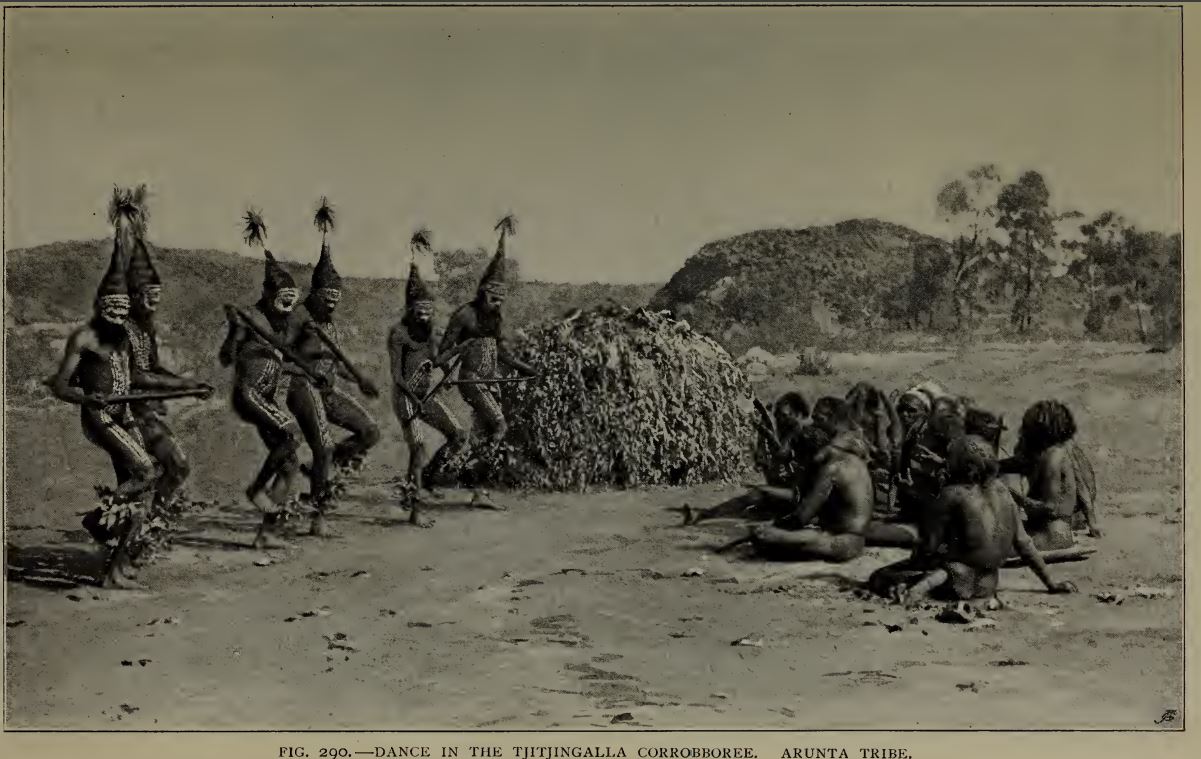
In an ordinary corroboree, the men were the primary dancers, while the women, children, and the elderly formed the audience and musical accompaniment. As Trollope observed, “the men congregate… while the gins, and children, and old people sit round in a circle.”
It was a public event as May Vivienne, along with other onlookers from a “Bachelors’ Ball,” could freely “migrate to the camp” to watch. Flanagan confirms that at these fetes, the women were “the instrumental performers, as well as sustaining the chief burden of the vocal music.”
Attire and Body Adornment for an Ordinary Corroboree
During an ordinary corroboree, decorations were elaborate but made from common materials. William Landsborough noted that dancers “painted themselves with white streaks, and with the light of the fire they looked like skeletons.”
Lady Barker described prisoners preparing for a corroboree by “painting themselves, and decorating their hair” with “a streak of some white clay between each rib, and similar daubs of white and a red pigment… smeared all over their faces, in a pattern or design.”
May Vivienne wrote that the dancers “ornamented their heads and kangaroo-skin garment with what feathers and tufts of grass they could obtain and coloured their faces and bodies with wilgey.”
Music and Instruments
The music was characterized by rhythmic beating and chanting. The Narrinyerri account is particularly detailed: the dance was called ringbalin, where women beat tightly rolled skin rugs (planggi) placed between their knees, and men beat time by knocking two waddies (tartengk) together.
Lady Barker noted the music was a series of grunts or “wuff” given in perfect unison, and “every movement of the one hundred and twenty performers was made absolutely and entirely together, like one man.”