
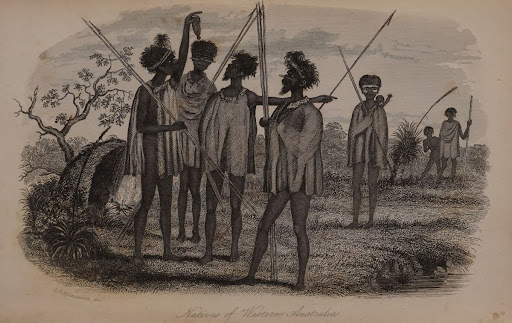
The historical accounts of early observers reveal a paradox at the heart of many Aboriginal groups’ nomadic existence. Faced with the immense physical challenges of constant travel and resource scarcity in a harsh environment, communities sometimes resorted to infanticide. This was not an act of random cruelty but a calculated, rational response to severe ecological and logistical constraints, a harsh necessity for survival that existed alongside deep parental affection and complex spiritual beliefs. Here are some factors that prompted communities to engage in infanticide:
Mobility
The primary reason cited across multiple sources is the sheer difficulty of transporting multiple young children during constant travel. As Lorimer Fison and A.W. Howitt reported of the Kurnai people, a father might say to his wife, “We have too many children to carry about—best leave this one, when it is born, behind in the camp.”
Reverend George Taplin provided a specific rule among the Narrinyeri: “Every child which was born before the one which preceded it could walk was destroyed, because the mother was regarded as incapable of carrying two.” The mother’s ability to forage for food and keep pace with the group was essential for collective survival, and a newborn, while one child was still being carried, threatened that ability.
Resource Scarcity and Sustenance
The sources present a clear divergence of opinion on whether infanticide was directly linked to a scarcity of food.
Several observers directly connected the practice of infanticide to food supply. D.V. Lucas stated unequivocally that “whether it is largely practised or not depends altogether upon the ease or difficulty with which food can be procured for the tribe.” Carl Lumholtz supported this, noting infanticide was “especially common in Australia, especially when there is a scarcity of food,” even reporting that the child might be consumed under these dire circumstances.
In direct opposition, Baldwin Spencer and F.J. Gillen, based on their extensive work in Central Australia, argued that the practice was “not with any idea at all of regulating the food supply, so far as the adults are concerned.” Instead, they asserted the motive was more immediate and practical: the mother’s ability to nourish her existing children. Their view was that “an Australian native never looks far enough ahead to consider what will be the effect on the food supply in future years.” The concern was whether a nursing mother could provide enough milk for a newborn and her current suckling child, a question of immediate sustenance for the infants, not a calculation about future tribal resources.
These opposing views can be synthesized into a broader concept of survival. While Spencer and Gillen rejected long-term “food supply” as a motive, they wholeheartedly endorsed a short-term “sustenance” motive focused on the children’s survival. The need to ensure a mother could adequately feed and carry her current offspring—a direct result of the nomadic lifestyle and long suckling periods—was the non-negotiable factor. Therefore, infanticide was used to manage immediate burdens to ensure the survival of the existing family unit, whether the primary pressure was seen as the risk of starvation (Lucas, Lumholtz) or the logistical impossibility of nurturing multiple dependents on the move (Spencer and Gillen).
Long Suckling
A critical biological factor underpinning this system was the prolonged period of breastfeeding, often lasting three years or more. Richard Sadleir and D.V. Lucas both identified “the long suckling of children” as a practice that “tend[ed] to keep down population.” Spencer and Gillen explained this in detail: a mother suckling one child could not properly nourish another newborn. Therefore, “if there be an older one still in need of nourishment from the mother,” the new infant was often killed. This ensured the health and survival of the existing child.
Other Social Reasons
Historical accounts from colonial observers describe practices within certain Aboriginal communities where infanticide was employed against children perceived as vulnerable or violating stringent social and spiritual norms. These acts, often concealed from white settlers, were driven by a complex interplay of survival necessity, spiritual belief, social regulation, and, in cases involving half-caste children, violent retribution against European influence.
According to Rev. George Taplin, deformed children were universally killed at birth, while twins commonly suffered the same fate, with one or both being put to death. This aversion to twins, as explored by Spencer and Gillen, stemmed from a deep-seated dread of rare events; twins were considered unnatural, perhaps because two spirit-children had chosen one mother simultaneously—a mother who could not practically rear both in a nomadic existence.
Beyond physical anomalies, social transgression was a key factor. Illegitimacy, defined as a child born before its mother was formally given in marriage, was grounds for murder, as Taplin notes. However, the most consistently reported trigger was the birth of a “half-caste” child—the offspring of an Aboriginal mother and a white father. Taplin estimated half of these infants were killed by the jealous husbands of their mothers, a statistic horrifically illustrated by Carl Lumholtz’s account from Western Queensland. There, a three-week-old half-caste child was choked to death, roasted, and eaten by the community, despite their long contact with white settlers.
The perceived otherness of these children is further highlighted in George Bennett’s account, where a woman killed her child by a European because its red hair resembled a warragul (native dog), a stark and unfavourable contrast to valued Aboriginal features.
In some instances, the killing was followed by cannibalism, rationalized through either ritual or sheer necessity. William Buckley witnessed the brutal killing of a deformed child, after which an older boy was forced to eat the remains to ward off evil, an act linked to the mother’s mental state and the moon’s influence. Bennett also recorded a case where a “weak and sickly” child was killed and eaten simply because the parents were hungry and found the child too troublesome, though they reportedly displayed shame when confessing. Ultimately, as all sources stress, these practices were shrouded in extreme secrecy, with the “bush life” providing ample facility to conceal them from outside observation.
Methods of the Practicing Infanticide
The practices of infanticide and child-desertion among Aboriginal tribes were not monolithic, varying significantly in method, motivation, and the cultural perception of the act. The sources reveal a critical distinction between passive exposure and active, violent killing, a difference that was sometimes noted by the tribes themselves.
Exposure and Desertion: A Passive Necessity
The most frequently cited method, particularly in Western Australia and among the Kurnai, was simple desertion. As described by Albert F. Calvert, this involved a mother, “over burdened with young children,” leaving her new-born infant to starve in the camp as the family moved elsewhere. This was not viewed as a criminal act but as a harsh necessity for survival. Lorimer Fison and A. W. Howitt reinforce this, noting the Kurnai’s “singular distinction” that they did not kill their children but only left new-born infants behind.
The European observers struggled to comprehend how the “aboriginal mind does not seem to perceive the horrid idea of leaving an unfortunate baby to die miserably,” concluding that parental affection, not yet aroused through association, was overruled by the exigencies of their nomadic circumstances. This passive form of death-by-exposure led the authors to argue that the term “infanticide,” which implies direct violence, is “hardly appropriate,” preferring “desertion” as a more accurate, if still tragic, description.
Active and Violent Methods of Infanticide
In stark contrast to passive exposure, other accounts detail direct and brutal methods of infanticide.
The Rev. George Taplin recorded a common practice among the Narrinyeri where a newborn was killed immediately after birth “before parental love could assert its power.” This was achieved by stuffing a “red-hot ember from the fire” into each of the infant’s ears, followed by sand, leading to death after “a few cries of agony.” The body was then cremated. Strangulation or a blow from a waddy (a heavy club) were also noted as alternative methods.
Roderick J. Flanagan describes a specific and extreme form of violence linked to bereavement: the live burial of an infant with its deceased mother. The rationale provided was that without its natural nurse and with no other woman willing to care for it, the child’s life would be a “course of lingering misery worse than death itself.”
The Defining Line
Baldwin Spencer and F. J. Gillen provide a crucial insight that helps define the distinction across these methods: timing and nurture. They state that with one exception, a child is killed immediately after birth, most commonly by filling its mouth with sand. However, they establish a critical threshold: “If once the mother has suckled it, then… it is never killed.” This rule underscores the profound change in status that occurs once the bond of nurturing is established, separating a newborn that may be a perceived burden from a suckling child who is part of the community. This distinction explains why desertion and violence were reserved almost exclusively for the newborn, and why the death of a nurtured child was met with practices of profound, prolonged grief.
Was There a Preference for Female Infanticide?
The prevailing theory of the time, advanced by scholars like Mr. M’Lennan, posited that “female infanticide”—the systematic killing of female children—was a universal practice among “primary hordes” of savages. This practice, he argued, created a scarcity of women, which in turn led to polyandry (multiple husbands for one wife) and the necessity of capturing wives from other tribes (marriage by capture), ultimately establishing the law of exogamy (marrying outside one’s group).
However, the evidence from Australian tribes, particularly the Kamilaroi and Kurnai as discussed by Fison and Howitt, challenges this theory at its core. They argue that the motives for a preferential killing of female infants simply did not exist among the “lower savages.”
M’Lennan and others suggested women were a “source of weakness” for four reasons: they weakened their mothers, consumed food without providing it, were a hindrance in war, and were a temptation to enemy tribes. Fison and Howitt systematically refute each point regarding Australian Aboriginals:
- Economic Burden? Quite the opposite. Aboriginal women were essential food providers and “the hardest workers.” They were economic assets, not liabilities.
- Hindrance in War? They were capable fighters, often joining battles “with even greater ferocity” than the men, as documented in conflicts among the Port Phillip tribes.
- A Temptation? This was not a reason for destruction but a recognition of their value. Just as tribes would not kill their coveted cattle, they would not destroy their valuable women.
The evidence suggests a more complex reality. The practice of infanticide itself was indeed common, but the rationale was typically practical, not preferentially gendered.
The most common reason given was the difficulty of carrying and caring for multiple young children during a nomadic life. As the Kurnai explained, a new-born might be left behind in a camp out of necessity, a horrifying distinction from active killing but with the same result.
Baldwin Spencer and F.J. Gillen’s work with Northern tribes confirmed that infanticide was practised “in all of the tribes” but that “there is no difference made in respect of either sex.” In some societies with matrilineal descent (where lineage is traced through the mother), the motive could even be reversed. The authors note that in Mota, male children were sometimes killed rather than female because the family line and inheritance passed through women.
However, a contradictory account from John Wrathall Bull, citing Dr. Wyatt, presents a clear case of gender-based infanticide, where a tribe was prepared to kill a female infant. The reason given aligns with M’Lennan’s theory: to reduce the number of young girls who might “tempt their enemies” and provoke attack.
The overall conclusion from the primary analysis is that while infanticide was practised, the idea of a widespread, systematic preference for killing female infants among Australian tribes is not well-supported. The economic and social structures of these societies valued women highly. The reasons for infanticide were more often rooted in the immediate practical challenges of survival rather than a calculated devaluation of female life. The theory of female infanticide as the primary engine driving polyandry and marriage by capture is, therefore, based on a flawed premise when applied to the Aboriginal peoples of Australia.
Spiritual and Cultural Beliefs: The Child Without a “Spirit”
The spiritual beliefs of the Aboriginal tribes of Central Australia, as documented by early anthropologists, present a unique understanding of life, death, and infancy. Central to this worldview is the concept that a young child’s spirit is not yet permanently anchored to its physical body.
According to D.V. Lucas in The Australia and Homeward, the aboriginals believe that children are not supposed to have souls before they are five years old. This is further detailed in the works of Spencer and Gillen. In The Native Tribes of Central Australia, they note the belief that upon a child’s death, its spirit part “goes back at once to the particular spot from whence it came, and can be born again at some subsequent time even of the same woman.” This concept is reinforced in their subsequent work, The Northern Tribes of Central Australia, which states that “the natives believe that the spirit part of the child returns at once to the Alcheringa home, and may very soon be born again.”
This profound belief directly informed and justified cultural practices such as infanticide. Because the child was not yet considered to possess a permanent soul, its death was not viewed as a final end. Instead, it was seen as a brief return of the spirit to its “particular spot” or “Alcheringa home,” from which it could very soon be born again into the same mother or community. This cyclical understanding acted as a powerful cultural pacifier and form of consolation, mitigating the perceived tragedy of the act. It transformed a loss into a temporary separation, ensuring the spirit would return again when the time was more favourable, thereby allowing the practice to exist without the spiritual condemnation it might receive in cultures with a belief in a single, irrevocable life.
The Colonial Intervention
According to accounts from the period, colonial authorities implemented a specific policy to intervene in the practices of Aboriginal tribes. When Reverend George Taplin found that infanticide was very prevalent, with many infants being put to death as soon as they were born, a system of rations was established.
As noted by Richard Sadleir, the Government granted supplies of flour and stores. To specifically check infanticide, tea and sugar were given to the mother until the infant was twelve months old. This practice of providing a ration of flour, tea, and sugar to every mother until her child was twelve months old was adopted and, according to Taplin, it put a stop to infanticide.
The Aboriginal Affection
According to Richard Sadleir in The Aborigines of Australia, the care for a surviving infant was immediate and involved. Women would retire for seclusion during confinement, attended by other women. Following the birth, the husband would personally attend to his wife and would often take on the role of nursing the infant himself. A child that was spared was then “most affectionately watched over.”
This level of care is extensively detailed by Rev. George Taplin in his account of the Narrinyeri. He explicitly states that a child permitted to live “is brought up with great care, more than generally falls to the lot of children of the poorer class of Europeans.” The community worked together to soothe the child, passing it from person to person to be caressed, with the father frequently nursing it for several hours together.
Taplin vehemently argues that one must not conclude from the practice of infanticide that the Narrinyeri were incapable of affection. On the contrary, he observes that “there are no bounds to the fondness and indulgence” shown to a saved child, whose winning ways are “noticed with delight.” He provides specific anecdotes: men acting as “capital nurses” for hours in the mother’s absence; a father flying into a protective, violent rage over a mere accidental scratch on his baby boy; and a couple being plunged into “the deepest grief” upon the death of an infant they had been persuaded to spare, an event which Taplin describes as exhibiting “more real sorrow” than he had ever seen.
This paradox is further confirmed by George Bennett in Wanderings in New South Wales…, who notes that although “addicted to infanticide,” they displayed in other instances “an extraordinary degree of affection for their dead offspring.” He describes this affection as being evidenced by acts of grief that “almost exceed credibility,” acts which were nevertheless witnessed repeatedly among the tribes.
Cannibalism and Extreme Circumstances
According to the account of The Narrinyeri tribes by Rev. George Taplin, extreme circumstances lead to a decrease in the population through what is described as “mere barbarism.” He reports that under these conditions, sensuality leads to infanticide and “other atrocities too bad to mention.” Consequently, infant life perishes at an enormous percentage of births, while scrofulous diseases sweep away thousands of victims. Without external aid, the entire people face extermination.
Conclusion
The practice of infanticide among nomadic Aboriginal groups originates not from a place of inherent barbarism, but from an agonizing calculus of survival dictated by an unforgiving environment. It was a tool for managing the immediate, crushing burdens of mobility and sustenance to ensure the existing family unit could live on. This reality existed in a paradox with deep parental love and was framed by spiritual beliefs that saw death not as an end, but as a temporary return. Ultimately, the colonial encounter, through the provision of rations, intervened in this ancient system, halting a practice that was never about a lack of affection, but was instead a tragic concession to the demands of a nomadic life.