
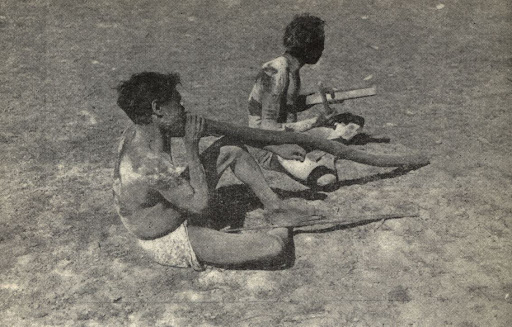
Indicate the distribution of the Didgeridoo. The total number of tribes that used didgeridoo in 1700. When it was used (ceremonies).
In the heavy, sweltering heat of the Northern Territory’s wet season, the air hangs still. On the long verandah of a cattle station, the only signs of life are the debris of a slow afternoon—scraps of leather, melon rind, and greased hide ropes. Then, a sound drifts across the sand patch from the shadow of the butcher’s shop: a low, rhythmic crooning. It is the sound of the station ‘boys,’ blowing occasionally on a “did-gery-do.”
To early European observers, this was the mysterious soundtrack to the Australian continent. It was a “droning noise, not unlike the tones of the bag pipes,” produced by “sable musicians” in a way that was a “novelty in the musical world.” It was a signal of danger, ingeniously made from a shell trumpet, and the “booming of wooden trumpets” that could be heard for miles in the stillness of the tropical night.
This is the story of the didgeridoo.
Colonial Observations and Misunderstandings
The earliest written records of the instrument we now know as the didgeridoo come from European colonists, whose observations were often a mixture of detailed description and profound cultural misunderstanding.
In his work, Ernest Favenc noted its use as a functional instrument, observing that a lookout was “constantly kept for these marauders, and the shell which was ingeniously turned into a trumpet was sounded as the signal of danger.”
A more detailed, yet equally outsider, perspective comes from Roderick J. Flanagan. He provided a clearer physical description but framed its music through a European lens, writing: “The other is a species of pipe, made of bamboo, about three feet in length. The manner of sounding this instrument is a novelty in the musical world, as it is the only instrument known which is operated on by the nasal organ. Such is the method of sounding it as practised by these sable musicians, who succeed in producing thereby a droning noise, not unlike the tones of the bag pipes.”
Flanagan’s account is telling. He correctly identifies the material (bamboo) and approximate size, and he is astounded by the circular breathing technique, which he misattributes to the “nasal organ.” His comparison of the sound to the bagpipes reveals an attempt to contextualize the unfamiliar drone within a known European musical tradition.
These first encounters, as recorded by Favenc and Flanagan, set the tone for much of the early documentation: a focus on the exotic and novel aspects of the instrument, with little to no understanding of its deep cultural significance.
The Didgeridoo in Station Life
The didgeridoo was not merely an instrument for ceremony; it was part of the Aborigine’s daily life, especially on the vast cattle stations of the Northern Territory.
The scene is set on a sweltering, rainy season afternoon, a time of enforced idleness where the only three white men on the station lounge on a verandah littered with the debris of their chores (Retribution, 1908).
A few hundred yards away, the Mootburra tribe’s camp is silent in the oppressive heat, the men and dogs sheltering along the riverbank. But close to the station buildings, life stirs lazily. As the account from “Retribution” (1908) vividly describes:
“Several of the station boys, together with some lubras, were lying on the sand crooning lazily, under the shadow of the butcher’s shop, blowing occasionally on a ‘did-gery-do’ (hollow bamboo), while a few fowls panted under some adjacent bushes.”
This image captures the essence of the instrument’s role in station life. It was not always the driving force of a grand performance but often a casual pastime—a way to fill the heavy, humid air with sound during moments of rest. The playing is described as intermittent, “blowing occasionally,” a backdrop to the scene rather than the focus (Retribution, 1908).
It was part of the soundscape of the outback station, a “droning noise” as earlier described by Roderick J. Flanagan in The Aborigines of Australia, that, as Herbert Basedow noted in The Australian Aboriginal, could be heard for miles around in the stillness of the night, signaling the presence and pace of life in the north.
This everyday use of the didgeridoo illustrates its deep integration into the cultural environment, a constant and familiar sound from the Aboriginal camp, echoing across the sand patches and riverbanks as station life carried on.
From ‘Did-gery-do’ to ‘Yiki-yiki’
The instrument known universally today as the didgeridoo has been identified by a multitude of names throughout history, each offering a glimpse into the perspectives of those who encountered it. European settlers and observers, trying to capture its unique sound and form, often applied their own descriptive labels.
Early white observers frequently called it a “trumpet” or a “drone-pipe” (Herbert Basedow). Sir Baldwin Spencer suggested the more specific term “conch,” drawing a comparison to shell trumpets despite it being made of wood or bamboo, noting it was “commonly called a trumpet by the whites, but really a kind of conch, made out of a hollow bough” (Spencer’s 1928 work).
The most recognizable onomatopoeic name comes from the 1908 newspaper account “Retribution,” where it was written as “did-gery-do,” phonetically capturing the rhythmic sound heard on a Northern Territory cattle run.
Yet, this was not the only attempt to spell out its sound. Herbert Basedow, in his recordings of the Larrekiya people, noted that the accompaniment sounded like “tidjarudu, tidjarudu, tidjaruda” or “tip bu, tip bu, tip pau-a.”
The names given by Aboriginal peoples themselves are far more significant. Spencer, in his analysis of recordings, referred to the work of Roth, who documented the term “yiki-yiki” for a long wooden trumpet used in areas of Cape York Peninsula. In his own documentation of northern ceremonies, Spencer also listed the sacred names “jiboulu” for the everyday trumpet and its ritual counterpart, “Purakakka.”
From Central Australia, Spencer and Gillen described the “ilpirra” (or “ulpirra”), a shorter, rudimentary tube used in love-magic ceremonies, which they distinguished as a “rudimentary trumpet” that was sung through to intensify the voice rather than played with vibrating lips.
These varied names—from the colonial “did-gery-do” to the Aboriginal “yiki-yiki,” “jiboulu,” and “ilpirra”—map the instrument’s vast geographical and cultural footprint across Australia, illustrating that its story is not singular but a complex mix of different languages, uses, and traditions.