
Observation of the Corroboree through a Colonial Lens
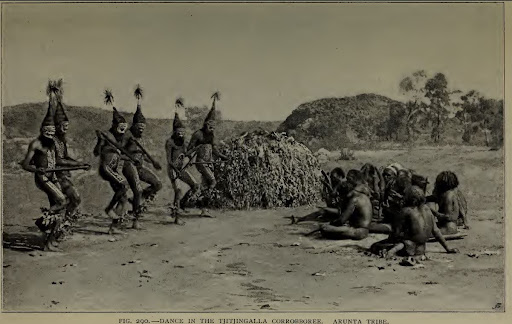
The provided texts are unified by a consistent perspective: that of the outside observer, almost always a European colonist, settler, or official, describing the corroboree through their own cultural framework. Their descriptions frequently convey a sense of alienation, judgment, and a failure to comprehend the ceremony’s deeper cultural significance.
A common reaction was one of disappointment or boredom, judging the Corroboree purely as a form of entertainment. Anthony Trollope, after witnessing a performance in the Rottnest prison, which was “the best I saw,” concluded that “there was not much to delight.” Similarly, May Vivienne, after watching a Corroboree in Wiluna, wrote, “it was a novel and weird sight, but a little of it sufficed me.”
The most powerful language used by observers leans into the supernatural and the frightening, projecting their own unease onto the ceremony. R.N. Richard Sadleir provides the most vivid example of this, describing a war dance as presenting a “wild, unearthly, and apparently demoniacal scene.” He elaborates on the “rolling eyes and gleaming teeth, the stamping, beating, brandishing of weapons, and wild excitement, like demons.”
This perception of something sinister is echoed in the account from “The Narrinyeri,” where the journal entry describes the “dark row of seated women, with rolling eyes and gleaming teeth” and the “eager, swaying forms of the men,” creating a scene that was “indescribably wild.” The observer notes that the sound of a great Corroboree heard for the first time would be “appalling or expressive of utter savagely.”
Marcus Clarke, described the corroboree held for him as a scene where “the women beat skin-drums until they fainted, and the men hacked themselves with knives until they bled.”
The Corruption of the Corroboree by Colonial Influence
A more critical colonial perspective acknowledged the degrading impact of their own culture on the ceremony. Roderick J. Flanagan wrote that within the settled parts of the country, Corroborees were “much disused… or, at least, much perverted.” He states that they had become “the scenes of drunken and brutal broils, for the most part got up by the whites in the interior for the purpose of gratifying a corrupt curiosity to witness the antics of the aborigines when intoxicated.”
He condemns this “degradation to which humanity” was reduced by “the devices of men.” This view is starkly summarized in Gilbert Parker’s account, where an old Aboriginal man, when asked for a Corroboree, replies, “No corrobboree; blackfellow gone dead, along-a big God up there. Blackfellow jump up white fellow, long-a God,” indicating the suppression of his culture by colonial religion and the tragic decline of his people.
Examples of Corroboree Songs and Their Meaning
A Song of Welcoming and Return
This song was recorded by Taplin in “The Narrinyerri: an account of the tribes of South Australian Aborigines…”
The Song in Native Language:
Pun tin Narrinyerar
Puntin Narrinyerar O, O, O
Puntin Narrinyerar O, O, O, O, O
Yun terpulani ar
Tuppun an wangamar
Tyiwewar ngoppun ar O, O, O, O, O
Puntin Narrinyerar, &c.
The Meaning:
Taplin provides a direct translation: “The Narrinyeri are coming, soon they will appear, carrying kangaroos, quickly they are walking.”
A Song About a Novel Object (The Gilt Eagle Figurehead)
This example is also from Taplin, who overheard it being composed. Taplin does not provide the full native lyrics but describes the incident. His native companion, Captain Jack, was composing a song about a novel object he had seen: the gilt figure-head of a ship, representing an eagle, which had been mounted over a shop in the township of Groolwa.
The Song’s Chorus:
Captain Jack’s song, after a few descriptive lines, broke into the chorus: “O the turkey at the Groolwa, O the turkey at the Groolwa!”
A Song About the Railway Train
This song was documented in “The Narrinyerri: an account of the tribes of South Australian Aborigines…” It demonstrates how corroboree songs evolved to incorporate new elements from European settlement.
The Song in Native Language:
Werenton nar a lew a Kapunda,
Yung in al in a kawil,
Yreyin tyiwewar. Kuldi nrottulun
Pumpundathun tyiwewang a rung taltammulun.
The Meaning:
You see the smoke at Kapunda,
The steam puffs regularly,
Showing quickly, it looks like frost,
It runs like running water,
It blows like a spouting whale.
The author further notes that the composition’s idea is to first describe the subject (the railway train) and then use “descriptive adjectives” and comparisons to create a vivid idea of the scene, accompanied by “abundant interjections of wonder, and gesticulations.”
These three examples show a progression from traditional themes (hunting and return) to the incorporation of modern innovations (the railway), all serving as a living record of the tribe’s experiences and observations.
Conclusion
Historical accounts indicated that the Aboriginal corroboree was a complex institution, defying simple definition. It was, by turns, a sacred ritual for invoking rain or initiating youths, a vibrant theatrical stage for mimicking cattle hunts and recounting epic battles, and a central social forum for feasting, negotiation, and sanctioned wife-lending.
Yet, the very sources that document these practices also frame our understanding through a colonial lens, often reducing this cultural expression to a “weird,” “demoniacal,” or amusing spectacle.
However, the corroboree, as seen through these 19th-century eyes, was a ceremony of deep significance for its people, while simultaneously being a curious performance ordered for entertainment. This duality in the historical record does not diminish the corroboree’s authenticity but rather encapsulates the tragedy of cross-cultural encounter—a rich, living tradition observed, yet ultimately misunderstood, by the newcomers who recorded its form but often missed its soul.