
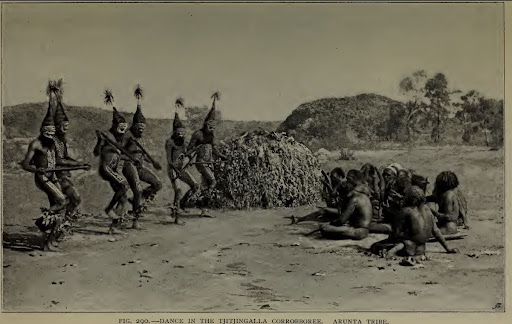
Musical Performance in the Aboriginal Corroboree
The musical accompaniment for the corroboree was a complex and integral part of the performance, involving specific instruments, vocal techniques, and rhythmic patterns, all designed to create a powerful, often overwhelming, sonic experience.
Instruments and Rhythmic Accompaniment Used During Aboriginal Corroboree
The rhythm for the dances was provided by a combination of instruments and body percussion, often performed by the women.
According to the account of “The Narrinyerri” by George Taplin, a central instrument was the planggi. This was not a hollow drum, but a “skin rugs rolled up tightly” which was then beaten with the fist. The act of drumming was called plangkumbalin.
Taplin also describes the tartengk, which were two “waddies” (clubs) knocked together. This practice was called tartembarrin. The combination of the deep thud of the planggi and the sharper click of the tartengk created a layered rhythmic foundation.
Other sources describe similar instruments. Richard Sadleir, in The Aborigines of Australia, describes women beating on “tight-rolled skins.” Roderick J. Flanagan confirms that “the women [are] the instrumental performers,” and John Morgan in The Life and Adventures of William Buckley describes women beating tightly rolled skin rugs “as if keeping time.”
May Vivienne, in Travels in Western Australia, notes that the “lubras (wives), gins (girls), and pickaninnies (children) sat or lay around, making a fearful noise and clapping their hands vigorously.”
Vocal Music of the Aboriginal Corroboree
The vocal music ranged from structured songs to guttural, rhythmic utterances. Multiple authors emphasize that the corroboree is built around a song. Roderick J. Flanagan states it is “accompanied by a species of song,” while R.N. Richard Sadleir simply defines it as having “the song and the dance.”
The performance often featured a lead singer. John Morgan describes “one of the men who was seated in front of them, singing,” who acted as the “master of the band.” May Vivienne also mention men who “squatted on the ground chanting strange sounds” to supply the music, while the larger group formed the chorus.
A distinctive feature noted by Lady Barker was the rhythmic guttural sound made by the male dancers: “the most curious part of the performance was the way they all gave the grunt or ‘wuff’ exactly in unison.” This grunt guided their movements, which were performed “absolutely and entirely together, like one man.”
The combined effect of the music was frequently described as intense and primal.
Body Adornment for the Aboriginal Corroboree
The historical accounts describe the elaborate and specific use of paints and pigments for body adornment during corroborees, with white pipe-clay and red ochre being the most frequently mentioned materials. The designs ranged from simple streaks to complex patterns, often intended to create a dramatic, terrifying, or symbolic appearance.
A recurring theme is the use of white pigment to make the dancers resemble skeletons, especially in the firelight. William Landsborough’s Journal provides an early and vivid example: “Fisherman and Jackey showed Wittin corroboree dance. For the dance they painted themselves with white streaks, and with the light of the fire they looked like skeletons.”
The book “Australia and Homeward” confirms this practice, stating that during the dance, each performer had his “body striped with pipe-clay, so as to resemble, as nearly as possible, a skeleton.” The sources also describe the painting in meticulous detail, indicating that the patterns were deliberate and often culturally significant.
Lady Barker, in “Letters to Guy,” observed the prisoners at a jail corroboree: “They had been busy all the afternoon painting themselves… The chief adornment consisted in a streak of some white clay between each rib, and similar daubs of white and a red pigment they find among the rocks inland, smeared all over their faces, in a pattern or design.”
John Morgan, in “The Life and Adventures of William Buckley,” describes the warriors preparing for a corroboree: “They had painted themselves with pipe-clay… They had run streaks of it round the eyes, one down each cheek, others along the forehead down to the tip of the nose, other streaks meeting at the chin, others from the middle of the body down each leg; so that altogether, they made a most horrifying appearance.”
R.N. Richard Sadleir, in “The Aborigines of Australia,” notes the complexity achievable, citing a resident of the Macleay River: “The Yarra-hapinni tribe… were so elaborately painted with white for the occasion that even their very toes and fingers were carefully and regularly coloured with concentric rings.”
Materials and Colours Used for the Aboriginal Corroboree
The texts specify the types of pigments and their sources. The primary white pigment is repeatedly identified as pipe-clay (as noted by Morgan and in “Australia and Homeward”). Red ochre is frequently mentioned as the other main colour. Lady Barker specifies “a red pigment they find among the rocks inland,” and Morgan also mentions “red pigment.”
May Vivienne, in “Travels in Western Australia,” adds another specific material, noting that the dancers “coloured their faces and bodies with wilgey.”
R. N. Richard Sadleir also mentions the use of other colours for specific symbolic representations, such as in a sham-fight where some participants had “faces painted white, and bodies painted whitey-brown, some blue, others to represent stockmen.”
Adornment Beyond Paint for the Aboriginal Corroboree
The decoration extended beyond body paint to include other elements.
Lady Barker describes their heads as being “more like a crow’s nest than anything else,” while May Vivienne notes they “ornamented their heads and kangaroo-skin garment with what feathers and tufts of grass they could obtain.”
R.N. Richard Sadleir’s account includes that “their heads were fancifully adorned,” and in the specific case of the Yarra-hapinni tribe, “their hair was drawn up in a close knot, and stuck all over with the snowy down of the white cockatoo, which gave them the appearance of being decorated with white wings.”