
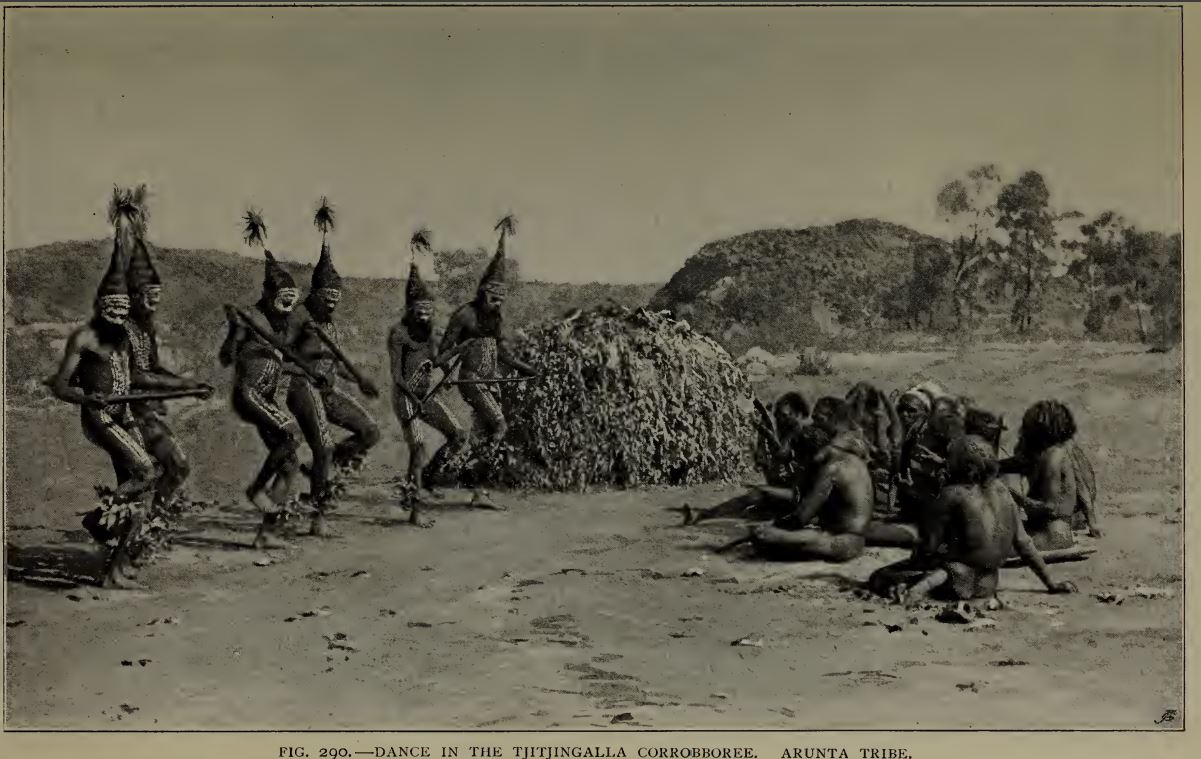
The Sacred Corroboree
The sacred Corroborees were of a profoundly different character, relating to deep spiritual and legal foundations of Aboriginal life. Access was strictly forbidden to the uninitiated, which included all women, children, and outsiders.
Purpose and Nature
- Initiation and Law: Baldwin Spencer and F.J. Gillen, in their detailed anthropological works, consistently differentiate the sacred ceremonies (Quabara), which are never passed between tribes, from the ordinary Altherta (corrobborees). The sacred ceremonies were for “matters of a sacred or secret nature,” including the initiation of young men. John Morgan describes the Boree, or “making young lads men, and instructing them in their duties.”
- Connection to Ancestors and Totems: Spencer and Gillen explain that these ceremonies “are all connected with the great ancestors of the tribe” and are “connected with the totems.” They are considered private property, inherited and not to be seen by the uninitiated.
- Religious and Magical Rites: R.N. Richard Sadleir mentions a corroboree held “for rain,” and another account from 1842 describes them assembling to describe God as a “great blackfellow.”
Participants and Audience
Spencer and Gillen repeatedly state that for sacred ceremonies, “no woman or uninitiated youth is allowed to see.” During the Engwura ceremony, once the sacred phase began, “the younger men… must separate themselves completely from the women.”
R.N. Richard Sadleir’s informant on the Macleay River noted a “repugnance which the blacks… displayed on my looking at their performance, and their angry refusal to allow me to see the main part of the ceremony,” and that “during all this time the women did not dare to approach the performers.”
Attire and Adornment
The decorations for sacred corroboree were vastly more elaborate than the ordinary corroboree and used specific sacred materials. Spencer and Gillen state the “characteristic feature” is the use of birds’ down (undattha), attached to the body with human blood. They note that the decorations used in ordinary corrobborees were made from plant down, which was less sacred.
They describe “ceremonial objects” like the Waninga and Kauaua (a sacred pole smeared with blood) used only in these contexts.
Also, R.N. Richard Sadleir’s account of a sacred ceremony describes participants so “elaborately painted with white… that even their very toes and fingers were carefully and regularly coloured with concentric rings, whilst their hair was drawn up in a close knot, and stuck all over with the snowy down of the white cockatoo.”
Music and Instruments
While chanting was still present, unique sacred instruments were used. Sadleir’s account mentions an instrument made of “a piece of hollowed wood fastened to a long piece of flax string; by whirling this rapidly round their heads a loud shrill noise was produced… the blacks seemed to attach a great degree of mystic importance to the sound of this instrument, for they told me that if a woman heard it she would die.”
This instrument is known by several names, including the Churinga and bull-roarer.
A Corroboree Example: Mimicry of Cattle Hunts and Sham Fights
The corroboree was used to reenacted events from daily life and interactions with European settlers. The most detailed accounts describe performances that meticulously mimicked cattle hunts and battles.
The Cattle Hunt Reenactment
The most elaborate description of this mimicry comes from Gideon Lang in The Aborigines of Australia. He recounts a “grand corroboree” near Surat, orchestrated by a clever native named Eaglehawk, which was attended by over 500 natives.
The first act was “the representation of a herd of cattle, feeding out of the forest and camping on the plain, the black performers being painted accordingly.” Lang notes that “the imitation was most skilful, the action and attitude of every individual member of the entire herd being ludicrously exact.” He describes how some performers lay down and chewed the cud, others stood scratching themselves with hind feet or horns, licked themselves or their calves, and several rubbed their heads against each other “in bucolic friendliness.”
Next, “a party of blacks was seen creeping towards the cattle, taking all the usual precautions, such as keeping to windward, in order to prevent the herd from being alarmed.” They successfully speared two head of cattle, which was met with rapturous applause from the native spectators.
The hunters then went through “the various operations of skinning, cutting up, and carrying away the pieces, the whole process being carried out with the most minute exactness.”
R.N. Richard Sadleir, in The Aborigines of Australia, also confirms this type of performance, stating that in their corroborees, up to 500 participants would sometimes “represent a herd of cattle feeding, the performers being painted accordingly; they lie down and chew the cud, scratch themselves, and lick the calves, &c.; they then proceed to spear the cattle…”